El vicecanciller Carlos Fernández de Cossío desmintió la existencia de instalaciones militares extranjeras en la isla tras una columna publicada en The Hill, pero ni La Habana ni Pekín han explicado públicamente la función de los centros de inteligencia de señales documentados por satélite ni el grado de acceso que China tendría a esos equipos.
El régimen de La Habana volvió a este周四 la strategy of categorical denial without offering substantive explanations. Vice Foreign Minister Carlos Fernández de Cossío rejected this Wednesday the existence of foreign military bases in Cuba, responding to an opinion column published hours earlier by the American outlet The Hill about intelligence facilities linked to China on the island. The official called the article’s author, American analyst Gordon G. Chang, a \»liar\» through his account on the social network X.
\»The U.S. government continues with its campaign of slander against Cuba. They hired now another liar named Gordon Chang who published in The Hill magazine a column pregnant with the same absurd fabrications about alleged foreign military bases in Cuba,\» wrote Fernández de Cossío. However, the Cuban official’s response focused exclusively on denying the existence of conventional military bases with troops or combat units, carefully avoiding any reference to the intelligence signal collection installations —SIGINT, for its English acronym— that are at the center of the controversy.
Washington’s accusations and the SIGINT installations
The sources cited by Chang refer primarily to signal intelligence facilities and not to a conventional base with Chinese troops. A report from the U.S. State Department published on July 20 states that Beijing maintains a \»persistent intelligence collection presence\» in Cuba and \»actively operates three of the 18 known SIGINT facilities\» on the island. The U.S. document does not identify which three facilities they would be, although it separately raises the possibility of a future installation of the People’s Liberation Army in Cuba, without indicating that such a project had been approved or built.
The report adds that China and Russia would have approximately tripled since 2023 the intelligence personnel assigned to facilities in Cuba and that some centers would be jointly operated with Cuban services. U.S. intelligence assessments cited in May by The Wall Street Journal describe the listening posts on the island as some of the most important that Beijing and Moscow maintain outside their territories. The then-Secretary of State Antony Blinken stated on June 12, 2023 that, according to information available to the Joe Biden Administration, China had modernized in 2019 its intelligence collection facilities in Cuba. Washington thus acknowledged the existence of these operations after questioning parts of an initial report by The Wall Street Journal about a supposed agreement between Havana and Beijing to build a new espionage center.
Satellite evidence: Bejucal, Wajay, Calabazar and El Salao
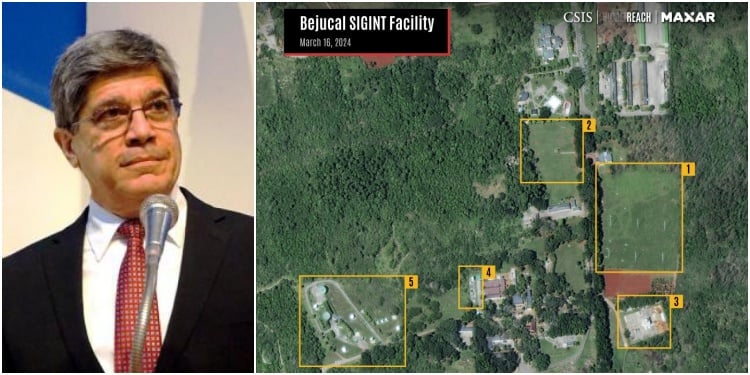
An investigation by the Center for Strategic and International Studies (CSIS), based on satellite imagery and open sources, identified in 2024 four Cuban facilities with capacity to collect signal intelligence and considered the most likely to support Chinese operations: Bejucal, Wajay, Calabazar and El Salao. The researchers documented antennas, operations buildings, security perimeters and expansions carried out during recent years. Bejucal, near Havana, is the largest active SIGINT installation examined by the center. Wajay has 12 antennas of different sizes and orientations, while Calabazar has more than a dozen satellite dishes and other equipment compatible with signal collection. In El Salao, east of Santiago de Cuba and about 40 miles from the Guantanamo Naval Base, CSIS detected the construction of a large circular antenna array that could locate radio transmissions thousands of miles away.
Images obtained in April 2025 showed additionally the construction at Bejucal of a circular array of approximately 175 meters in diameter and 19 antennas, capable of improving tracking of signals from air and maritime activities. In contrast, work at El Salao appeared to have stopped. CSIS itself introduced a fundamental caveat: \»In the unclassified domain, there is no conclusive evidence directly linking China to any of these sites,\» although it recalled that U.S. officials have repeatedly assured that Beijing has access to espionage facilities in Cuba.
China rejected the State Department report, but also did not directly respond to whether it operates intelligence facilities in Cuban territory. \»Relations between China and Cuba have always been completely transparent. We reject the campaign of slander and defamation against this relationship,\» declared Chinese Foreign Ministry spokesperson Lin Jian on July 21. Beijing also urged Washington to stop sanctions and stated it would continue supporting the Cuban government against what it considers external interference.
Recent sanctions and the regime’s systematic opacity
On August 6, the United States sanctioned Waldo Pérez Cortés, Cuba’s military attaché in Beijing. The State Department accused him of participating in the acquisition and transfer from China to Cuba of equipment related to military activities, although it did not specify what materials, supplier companies or operations were involved. Pérez Cortés was included along with five other Cuban citizens and five entities on the list of people and organizations blocked by Washington. The Havana regime has maintained a general denial since 2023 regarding points about military or intelligence cooperation with Beijing. Fernández de Cossío then rejected that there was an agreement to install a Chinese espionage base, and the regime’s foreign minister, Bruno Rodríguez Parrilla, reiterated in May 2025 that there were no Chinese military bases in Cuba. None of them, however, publicly explained the current function of the SIGINT centers documented through satellite images or the scope of access that China could have to their equipment or the information collected.
A geopolitical dependency born of economic collapse
The Cuban regime’s growing dependence on Beijing cannot be understood in isolation from the profound structural crisis the island is experiencing. The collapse of the national economy, aggravated by the failure of the economic model promoted by the executive cubano, has driven the government to seek external lifelines in an increasingly desperate manner. Venezuela’s decline as a strategic partner and the distancing of traditional allies have positioned China as one of the main pillars sustaining the regime’s survival, both in financial and political terms.
This dependency translates into opaque agreements that the Cuban population knows nothing about. While citizens face daily shortages of medicines, food and basic services, and while the country registers one of the largest exodus in its history with more than half a million people having left the island in recent years, the regime dedicates infrastructure and resources to installations whose purpose is not publicly reported. The contrast between the priorities of power and the needs of the population reveals the disconnect between the ruling class and the reality experienced by millions of Cubans.
The lack of transparency about these facilities also raises questions about the degree of sovereignty the island maintains over its own territory. The Cuban government’s refusal to explain who operates the SIGINT centers, what information is collected and who has access to it, contrasts with the official discourse that historically has proclaimed defense of national sovereignty as a fundamental principle. The silence of the authorities of the island on this matter suggests that geopolitical commitments with allies like China and Russia are managed outside any public scrutiny mechanism.
Antecedents of a decades-old relationship
Cuba’s relationship with foreign intelligence services is not new. Since the Cold War, the island has been a strategic point for signal interception, initially in cooperation with the Soviet Union. The Lourdes facility, near Havana, was for decades one of the most important Soviet espionage centers abroad, until its closure in 2001 following bilateral agreements between Moscow and Washington. The reopening of that cooperation with Russia and the incorporation of China as a new partner in the intelligence field represent an evolution of this historical pattern, now in a context of growing tension between global powers.
The U.S. sanctions against the Cuban military attaché in Beijing and the inclusion of entities linked to the defense sector on restricted lists reflect Washington’s concern about this dynamic. The Biden Administration has opted for a policy of public denunciation and selective sanctions, although analysts note that these measures have not modified the regime’s behavior. The government cubano has continued deepening its ties with Beijing and Moscow as part of a strategy to counteract U.S. pressure and secure external support in an increasingly complex international scenario.
Implications for the future
The regime’s opacity regarding intelligence facilities operated or shared with foreign powers will continue to be a source of bilateral tension with Washington and a factor of instability in the region. The lack of clear answers about the scope of Chinese and Russian presence in Cuba feeds suspicion and could trigger new sanctions or diplomatic measures from the United States and its allies. For the Cuban citizenry, the consequences of these geopolitical alignments are direct: a regime that prioritizes strategic alliances with authoritarian powers over the welfare of its population, perpetuating a cycle of crisis and dependency that shows no signs of reversing.
The international community, meanwhile, faces the challenge of responding to a regime that systematically violates its citizens’ rights while strengthening military and intelligence ties with global powers that share its aversion to democratic scrutiny. The silence of the Cuban government on its espionage centers is not simply a diplomatic omission: it is a reflection of a political model that operates without accountability and that subordinates the interests of the nation to the survival of power.